Sunday, September 15, 2013

Making Thai Green Curry

In their book Hot, Sour, Salty, Sweet , Jeffrey Alford and Naomi Duguid suggest buying fresh lime leaves any time you see them, and stashing them in the freezer for later use. I tend to do that, but then I'm not always so great about actually bothering to use them. I made green curry today because I wanted to use some lime leaves. And in the process I remembered how delicious and fun Thai coconut curries can be. I'm no expert, but I've been playing with these for a bit, so here are some thoughts.

First a word on curry itself. This has been rehashed over and over lately (see especially a great map of curries from all over the world in the spring issue of Lucky Peach), but many people have the mistaken belief that "curry" is a spice of some sort. This makes intuitive sense. Cumin powder is made from cumin. Turmeric powder is made from turmeric. Why wouldn't curry powder be made from, well, curry? And it's even more confusing because South Asian cooking uses something (totally unrelated to the powder) called a "curry leaf." But it's just not so. Curry refers not to a spice, but a style of cooking that involves a spiced sauce of some sort.

Thai curries typically involve a spicy paste and coconut milk (except "jungle curries," as coconut palms are scarce in the jungle), along with a protein and some vegetables. When cooked traditionally, this is a quite clever way of preparing a meal. Rather than cooking the protein in oil and then adding coconut milk (as is sometimes specified in US cookbooks), Thai cooks separate thick from thin coconut milk and use the thick milk as a cooking fat for the curry paste and protein.

It's worth noting here that not all coconut milk is created equal. It would, of course, be ideal if -- as in most Southeast Asian markets -- we could all just go buy freshly pressed coconut milk. Not the case here in Chicago, however, so I use canned. (It's also possible to make it yourself with fresh coconuts, but I haven't tried this yet as I'm not unhappy with the canned milk.) There are many brands to choose from, and it actually does matter because many are too thin to really cook with. I recommend Chao Koh, which is often easy to find. Arroy D is another common brand, but I don't like it as much. Avoid "low fat" or "light" canned coconut milk; it's just the normal stuff diluted with more water.

Then we get to curry paste. It's not hard to find decent curry paste in jars, but it's extremely rewarding to make it yourself. Tracking down the ingredients can take a bit of effort, but you can make a bunch at a time in the food processor and freeze it. Typically there are some dried spices (often coriander seed and cumin, sometimes mace or nutmeg) or chilies, and some combination of galangal, lemongrass, a scary number of fresh Thai chilies (often 20 or more!), shrimp paste, shallots, garlic and maybe another thing or two. The green curry paste I made today had a cup of fresh sweet Thai basil leaves as well.

Cooking the curry is quite clever. First, you separate the thick and thin coconut milk (one will usually pour out of the can first; it's not very scientific but be sure not to shake the can), and pour the thick milk (1 cup or so) into a hot wok. It will begin to lightly brown and thicken right away, which will give the curry a wonderful flavor. Stir it until it separates, and then add a few tablespoons of curry paste. This then gets stir fried until aromatic (or you have a coughing fit), and the protein is added to begin to cook it.


Once the outside of the protein is cooked (i.e., chicken turns white), the rest of the coconut milk is added to create a bubbling liquid. To this the vegetables are added and simmered. My green curry had eggplant (I used western-style eggplant, which is non-traditional but delicious). Yellow curries often have potatoes or carrots. If using eggplants, note that traditional Thai recipes often call for "big" or "small" eggplants. But it's important to know that, oddly, all Thai eggplants are smaller than you expect. "Big" ones are about the size of golf balls, while the smaller ones are the size of marbles. I've only seen the smaller ones in North America once; at Granville Island market in Vancouver.

After a few minutes of simmering the vegetables, you can add some fish sauce (for saltiness), possibly some palm sugar, and maybe -- yes, here they are -- some torn lime leaves (sans stem) for aromatics. In green curry you can also add some Thai basil leaves and perhaps strips of bell pepper. I like my coconut curries to be thick, so usually let the sauce reduce a fair bit at this point.

Then serve with some jasmine rice for a delicious and rewarding meal!


Wednesday, August 28, 2013

The Best Salad Ever

Greetings! It's been a while since I've posted anything, but it seems silly to write posts when I just don't have much to say. I've decided that Pearwise will continue as a sporadically updated site. If you're a reader, thanks for your patience and please check back periodically or turn on a notification of some sort.

Today I'd like to talk about my favorite salad. It's my favorite because it's never the same twice, it's always delicious and it can be made to represent at least two (and probably more) food cultures. It can also be made with any number of vegetables, easily scaled to accommodate a crowd, and stored in a plastic container for a few days if you don't finish it.

I'm talking about salad premised on chopped tomatoes and cucumbers. In India and South Asia this is called "cachoombar" (I'd bet that this word is related to "cucumber," but I have no evidence of this). In Israel it's often just called "salad" and is served for breakfast. In the US it might be called "Israeli salad" or (creatively) "cucumber and tomato salad." Part of the beauty of this salad is that it can be just that simple -- just cucumbers, tomatoes, some lemon juice, olive oil, salt and pepper. My mother swears by this version.

Simple beauty is great, but is not grounds for my calling something "the best ever." That requires a bit more versatility and tastiness. What I really like about this salad is the way it can be modified to become something totally different based on whatever you have. Go to the farmers' market or your favorite grocery store, buy what's good, and then make this salad.

For an Indian cachoombar salad, take the base of chopped cucumbers and tomatoes (1 of each, say) and add a chopped red onion, some cilantro, a chile pepper, juice of one lime and a teaspoon or so of a spice blend called "chat masala." You can make chat masala, but there are lots of components and it's pretty easy to find in a box in Indian grocery stores.  Or if you don't have chat masala, use some ground cumin, black pepper, and salt. Or just black pepper and salt. Or some other spices. Now you're getting the idea. If you want to get a bit non-traditional, try adding a diced ripe avocado (a small one will do). If it's really ripe, the avocado will break apart and "dress" the salad.

If you want a salad that's not as spicy and more middle eastern in character, get yourself some zaatar, which is pretty easy to spot in middle eastern groceries. Instead of onions in the above recipe, add a few diced scallions. Or radishes. Or both. Skip the chile pepper this time. Add about a teaspoon of zaatar. You could still use a lime, but lemon juice would be pretty tasty. Maybe add some olive oil for a more rich experience. Substitute flat-leaf parsley for the cilantro in this version. You'll also want a bit more salt this time, because chat masala has (black) salt and zaatar does not. An avocado is delicious in this version too, as is a bit of feta or other crumbly cheese (I used queso fresco today, because I had some around).

I've also added a red bell pepper to either version of this with much success. And I've tried it with different herbs, including rau ram (tasty, but perhaps not my favorite), mint (nice) and dill (subtle, but pretty good).

This salad is also great because it can be served in lots of different ways. Often I eat it alongside a meal. Sometimes -- particularly when I add lots of stuff -- I eat it as a meal in and of itself, with some bread or as a filling for pita. It can also be a delicious topping for bruschetta appetizers. And in the fine Israeli tradition established by farm workers on Kibbutzim (or so I'm told), it makes a wonderful breakfast.

So...have fun with this one. Eat the same salad every week like I do, but be sure you never eat the same salad twice!


Wednesday, March 13, 2013

Red Pepper Cupcakes with White Chocolate Icing

Completed cupcake
It's been a while since I've had a new food-related project. A recipe that involves lots of steps, some obscure ingredients and appliances like the juice extractor and dehydrator. I don't think I've even used my juice extractor since I moved to Chicago last summer. It was time.

I recently picked up Amanda Cohen et al.'s Dirt Candy, a unique cookbook from their restaurant. It's unique in a couple respects. First, it's my only cookbook in comic book form. It tells the story of their restaurant and provides recipes in an entertaining, quirky, graphic style that's a lot of fun. Second, it's a vegetarian cookbook that uses lots of fresh ingredients and flavors, while also using innovative techniques from the molecular gastronomy movement. It provides recipes for things that look like food, but prepared creatively and in interesting ways. It's a way to cook interesting food that doesn't feel like it came from a chemistry lab.

Making red pepper jam.
These cupcakes are my first project from this book, and "project" is the apt term. I didn't follow the recipe perfectly, but I came close. My only points of deviation were making cupcakes instead of a layer cake, and not serving them with ice cream and other recommended accompaniments.

The idea for these apparently comes from traditional red velvet cake, but the resemblance stops with the color. For starters, they're not even that red. Second, they're flavored and colored with, well, red bell peppers. And third, they have a white chocolate icing.

Grinding dehydrated pulp into powder
How do you color and flavor a cake with red bell peppers? It's a fair question, and there are several steps involved because the red peppers are transformed into many different creations. It starts with the purchase of a couple pounds of red peppers. About half of these get turned into a homemade red pepper jam (diced peppers cooked in pepper juice with some sugar, then pureed). The rest get turned into red pepper juice, which is reduced substantially to thicken it. And the pulp from the juice extractor is dehydrated and ground into a powder. All pretty clever, right?

So then you prepare a fairly typical cake batter, but the with red pepper powder mixed in with the butter and sugar, and some thickened red pepper juice mixed in with the wet ingredients (buttermilk in this case).

The icing is then made from melted white chocolate that gets beaten into a butter/cream cheese blend along with some confectioner's sugar. I added some lime extract for good measure.

To finish the cupcakes, I spread some red pepper jam on the top of each cupcake (instead of between the layers, as recommended in the book), and icing on top of that. The outcome? Tasty. Definite taste of red pepper. Moist cake. Creamy icing. Not the best thing ever and I might not make them again given the effort. But unique and well worth a try!  I'll foist them on some


Saturday, February 2, 2013

Coconut Lime Pandan Cookies

Finished cookies before glazing
It's been a while since I've posted because I haven't felt there's been much interesting to share. Mostly that's my fault. I've been making food, sure. But mostly from recipes and without a lot of creativity. More macarons. Some cookies. Blah blah. Tasty, but not very interesting to all of you. I decided to start  having more fun with food this weekend.

Oddly, my initial ideas for a project had nothing to do with any of the ingredients in the title of this post.  I've been meaning to do a green mango pie for a while, so thought I might try that. Or maybe a tart or layer cake, which are also things I've been meaning to do more of. So how did I get to these cookies?

Eggs and pandan paste
Part of it was just trying to use what I've got around. I bought a ton of limes last week for some reason, so needed to use those up. My usual way to use up limes is to make cornmeal-lime cookies from the Flour cookbook, but my motivation in the first place was to do something more original this weekend. I also have a ton of dried coconut powder around (as one does), and brought back some pandan paste from my December trip to Singapore. (As a reminder, here's a previous post about pandan leaves, from which pandan paste is derived)

So with all of that in mind, I decided to try to mix a couple recipes together and see what happened. In the Sweet Spot, Pichet Ong often uses the trick of substituting some toasted coconut powder for flour in his cookies and brownies (which is why I have all that coconut powder). So I decided to substitute toasted coconut powder for the cornmeal in the cookies, but use the ratio of butter-sugar-flour-coconut that Ong uses, rather than 1 for 1 subsitution.

Green dough/batter
The original cookie recipe also calls for a teaspoon of vanilla extract. I used the pandan in place of that. It looked bizarre in the bowl with the eggs (see photo) and gives the cookies an odd green hue, but I figure that makes them a little more interesting. I also added sweetened shredded coconut to the glaze, instead of the lime zest that's called for.

The result is pretty tasty. The pandan and lime play off of each other very nicely. The coconut flavor is probably too subtle, but the sweetened coconut in the glaze accentuates it nicely. If I made them again, I might work on ways to increase the presence of coconut. I might also use a bit less baking powder, because these really puffed up a lot.

Here's the recipe:

1 cup unsweetened dried coconut powder
1/2 tsp salt
1 cup (2 sticks) unsalted butter
finely grated zest of 4 limes
2 eggs
1 tsp pandan paste
2 cups (280 g) all-purpose flour
2 tsp baking powder

1. Pre-heat the oven to 350. Spread the coconut powder evenly on a baking sheet and toast it in the oven until it is golden brown and fragrant, 7 mins or so. Let cool completely.

2. Put the toasted coconut, sugar, butter and salt together in a stand mixer with paddle attachment and cream until light and fluffy (5 min or so).

3. Add the lime zest. Beat for 1 minute or so.

4. Add the eggs and pandan paste, and beat for another 2-3 minutes. Scrape down the sides to ensure even mixing.

5. Mix the flour and baking powder in a bowl. Add these slowly to the mixer while beating slowly.

6. Drop the cookies onto a lined (parchment or Silpat) baking sheet and bake 20 minutes or until golden brown around the edges. Cool on a wire rack, and glaze after 10-15 mins.


Glaze
1 cup confectioners sugar
2 tsp water
2 TBSP fresh lime juice
2 tsp sweetened grated coconut

Mix all together, then brush onto cookies.


Saturday, December 29, 2012

Eating in Singapore and Bali

Happy holidays and happy new year, dear reader!  I hope the season has treated you all well, however you chose to spend it. I've had the delightfully good fortune of spending the past couple weeks in southeast Asia, mostly with my sister Melanie's family in Singapore. While Singapore is a (_very_) long way to travel to see my favorite niece, it's also an amazing place to eat. I've discussed this on Pearwise before.

While I'm told Singapore has a great and interesting top-end restaurant scene, my favorite thing to do here is eat in small, local restaurants and hawker centers. I've eaten local food nearly every day since arriving here, and will share a few of my favorites with you here.

Murtabak and curry gravy
On the first day (before Melanie got back from a separate vacation), I went to a little Malaysian restaurant nearby that serves great murtabak. This is a fried pancake that's stuffed with mutton (or other meat options) cooked with garlic and onions. It's served with a curry gravy (much like a sambhar) and some sliced cucumbers. I like to dip bits of the pancake into the gravy or sometimes pour a little on top of each bite. It is extremely unhealthy and extraordinarily delicious.


Idlis, chutneys and dhal
Another favorite treat not local to Singapore, but entirely appropriate for the Little India neighborhood where Melanie et al. live is idlis and dosas. Our favorite spot for these is the Murugan idli shop (which is apparently a chain). Idlis are steamed pancakes made from a fermented batter of rice flour (of a particular type) and lentil flour. Dosas, as you may know, are very large, flat crepe-like pancakes made from a similar batter that are wrapped around a filling. At Murugan, these are served on a banana leaf with several types of chutney (here there's coconut, tomato, coriander and mint), and a bowl of dhal. You only pay for the pancake items. They will keep refilling the chutneys and dhal as long as you're sitting there. Idlis have a wonderful spongy texture that sops up the chutneys and a pleasant, slightly sour taste. I'd actually really like to make these myself, so I bought an idli steaming pan and you should watch for a post on my experience. And if you happen to be from South India, I welcome your advice.

Chili Crab
We did have one higher-end meal in terms of price, though it was a pretty simple dish. Singapore is known for chilli crab, a dish in which crabs are stir-fried in a sweet and spicy tomato-based sauce. As with other large shellfish, it's a lot of effort and a fairly messy endeavor, but the meat is tender and the sauce is delicious! The crab was served with some fried buns that were also pretty tasty, and we also had a mango salad with duck and some fried rice.

Seafood dish
Another highlight was when my friend Jude took me to a great little place just outside Chinatown where we had various wok-cooked specialties that I loved eating, but confess that I left ordering in Jude's able hands and don't recall the details. Among other things, we had some sort of wok-fried wide noodle dish and a seafood stew of sorts in a thickened sauce.

Eating prawn mee at the Old Airport
Road Hawker Centre
Plus Melanie and I went to the famous Old Airport Road Hawker Centre. There, we tried several recommended dishes including prawn mee (thin yellow noodles in a rich broth with prawns); char kway teow (fried rice noodles in a spicy brown sauce with Chinese sausage, vegetables, crispy bits of lard and fishcake); chee cheong fun (a large filled rice noodle roll covered in sweet soy sauce), and a curry puff (spicy curry encased in a puff pastry shell and deep fried). This was not a meal recommended by cardiologists, but seriously delicious.

Tropical fruits in Bali
There were many more highlights, of course. Fabulous fresh tropical fruits like mangosteens, tamarillos, soursop, mangoes, rambutans and passionfruit.  A weekend in Bali with plenty of satay, nasi goreng and nasi campur. Soup dumplings at Din Tai Fung. Laksa and otah at 328 Katong. So very much tastiness.

I also picked up a really nice Peranakan cookbook, so stay tuned for some posts on my experiences trying to recreate some of these dishes in Chicago!


Friday, December 14, 2012

Oatmeal Raisin Ice Cream

I've said this here before, but one of my favorite things about food is that the possibilities of what you can do with it are virtually limitless. We are mostly constrained by tradition and lack of imagination; and it can be fun to play with people's expectations. Ice cream can be a great way to do this because it is such a tasty canvas, and people's expectations are so often constrained by what's commercially available.

That's what excited me about David Lebovitz's recipe for oatmeal raisin ice cream. I had never had or heard of oatmeal raisin ice cream. Have you? Surely you've eaten cookies by that name; but probably not ice cream. This recipe takes the cookie as its inspiration and aims to replicate the experience in oatmeal form. This, as you might imagine, is not without challenges.

The first challenge is how to get oatmeal into ice cream. Simply tossing some raw oats into a custard base is probably not the tastiest way to do this, except perhaps if one is making ice cream for horses (who eat raw oats). Lebovitz solves this problem by making an "oatmeal praline" (he actually uses "praline" as a verb, but I didn't have the heart to do that). To do this, toast some rolled oats on a baking sheet in the oven while simultaneously melting some sugar in a large skillet on the stove. Once the oats are brown and fragrant, mix them into the just-caramelized sugar. Then pour this mixture onto a silpat-lined baking sheet to harden. Once hardened, break into small bits in the food processor. Ok, problem one solved.

The second challenge is the raisins. Dumped right into the ice cream they'd freeze and be hard little bug-like rocks. The solution: moisten them with syrup, and keep them soft with alcohol. The raisins get gently cooked in a sugar syrup, to which a couple tablespoons of whiskey are added at the end of the cooking. The raisins absorb the syrup and whiskey, so they are plump and sweet; and they stay soft and chewy in the freezer.


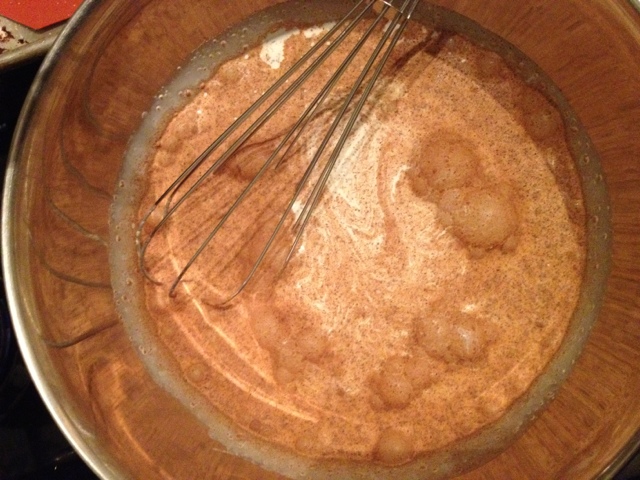
Finally, the ice cream itself. For this, Lebovitz uses a standard egg yolk custard, but it's sweetened mostly with brown sugar for color and a deeper flavor. A healthy dose of cinnamon is added as well, which you can see speckled in the mix.

This custard is then frozen in the ice cream maker, with the oatmeal praline and raisins tossed in just as it solidifies. A delicious treat!

In other news, I'm back in Singapore...so stay tuned for some Asian photos and treats!


Sunday, November 18, 2012

Making Macarons: A Healthy Dose of Humility

Imperfect macarons.
For those at least as obsessed with baked goods as I am, there comes a time when certain treats known to be difficult are too tempting not to try. Stuff like croissants, puff pastry and yes, macarons. It happens that many of these things are French. This is somehow unsurprising.

First, however, a quick and critical point of distinction that is echoed in virtually every English-language recipe for macarons I've ever seen. In a nutshell (no pun intended), these are not even close to the same thing as coconut macaroons (of the sort commonly seen in the US on Passover). Rather, these macarons are shells made from almond meal (yes, that's why it was a pun), egg whites, and sugar, that are then filled with richly flavored buttercream. When done well, they are sublime in a way the coconut counterpart can only dream of.

Ok, back to my story about trying difficult things. Every recipe for macarons notes that they are finicky and difficult. There are multiple web pages dedicated to macaron troubleshooting, and multiple videos. You can't whip the eggs so much that they dry out, or so little that they won't provide structure. You need to be sure the almonds are ground extremely fine, but can't run the food processor so long that they become a paste. You have to use egg whites, but they can't be fresh...you need to let them dry out a bit on the counter. And macarons are created by squeezing the batter from a pastry bag, preferably in perfectly round little formations that hold together, but don't have an obvious little pointy bit from the pastry bag tip. Plus they should be colored, but you can't use more than a couple drops of liquid food coloring. Obscure powdered colorings are the preferred strategy.

Dry ingredients.
Once they emerge from the oven, moreover, everybody can tell if you did it correctly or not. Did they puff up? Hopefully. Did they crack? Hopefully not. Are the bottoms perfectly flat? Hopefully. Did they turn brown? Hopefully not. Did they develop 'feet'? Hopefully. And are they perfectly round, shiny, smooth and free of blemishes? They better be!

Despite all of these very good reasons not to attempt macarons as a project, I got a new cookbook a few weeks ago (Sugar Baby by Gesine Bullock-Prado) that had an entirely too tempting recipe. So I decided to try them.

The first step was a shopping trip, as her recipe calls for "egg white powder." I had never heard of these, but was happily able to find some at Treasure Island. Then I needed almond meal, which it turns out Trader Joe's has at about half the price of similar products elsewhere. Oh, and I had to "age" my egg whites by leaving them on the counter for a few hours. Ok, all set to go.

Waiting for sugar to heat up.
The first step was to get all of the dry ingredients together (210 g almond meal, 200 g confectioners sugar and 14 g egg white powder) in the food processor and process until very fine, but not too long.

Next I put 3 "aged" egg whites and 3g of salt in my stand mixer, with the whisk attachment, to get them ready.

I then put 200 g of sugar and 1/4 cup water in a saucepan, stirring until the sugar dissolved and then heating until it reaches 240 F.

A few of my favorites.
Prior to this, though, I had started the egg whites beating when the sugar reached 210 F. This was just to get them foamy and ready for the sugar mixture, which got poured into the egg whites slowly down the side of the bowl (so the eggs don't scramble from direct heat) with the motor running at low speed. Once incorporated, I increased the mixer speed to high and let the egg whites beat until they held soft peaks.

Cracked macaron
Ok, now back to the dry ingredients. I first mixed 1/4 cup of water into these to form a paste (apparently this type of paste is good, though almond paste is not), into which the egg white mixture is then gently folded. They need to be combined until there are no more white streaks, but not over-mixed.

I then put this mix into my pastry bag, and piped it onto baking sheets covered with silicone mats, and baked for about 35 minutes at 275 F.

As you can see in the photos, a few of them came out nicely. They had feet! The tops were rounded! They were puffy and had flat bottoms!  But many did not. They cracked and/or had cratered bottoms, and didn't get very puffy.

Lime buttercream.
I did some troubleshooting to find out what I had done wrong. According to one web site that seemed possibly helpful, cracks are an indicator that your macarons have been mixed too much. Or that they have not been mixed enough. Thanks...  They still taste good, though.

And to fill them I made my first Italian-style butter cream made with egg whites and flavored with lime zest and lime juice.

They're pretty tasty. I'm thinking I'd like to try them again to see if I can get better results. Stay tuned!